Coverage & Datacube Standards at a Glance
Overview
Coverages - as per OGC, ISO, and INSPIRE standardization - constitute a unifying paradigm for the digital representations of space/time varying phenomena, in physics called "field" (as in magnetic field). Technically, such phenomena are represented as spatio-temporal regular and irregular grids, point clouds, and general meshes. In particular, multi-dimensional datacubes fall under this category, such as 1-D sensor time series, 2-D satellite imagery, 3-D x/y/t image time series and x/y/z geoscientific models, 4-D x/y/z/t climate and ocean data sets, and more.
Standardization: Coverage concepts and terminology (aka conceptual model) are laid down in ISO 19123-1 (data model) and ISO 19123-3 (processing model) which are identically adopted as OGC AT6.1 and AT6.3. The logical and physical model are defined in ISO 19123-2 (Coverage Implementation Schema, CIS), corresponding to OGC CIS which is harmonized with GML, SWE, and other OGC standards.
In OGC, the CIS data model is accompanied by a modular service model, the Web Coverage Service (WCS) suite of standards. Functionality of this Web API ranges from flexible datacube access and subsetting up to complex geo datacube analytics with the Web Coverage Processing Service (WCPS) geo datacube query language. WCS Core and WCPS are also adopted by EU INSPIRE (see the official INSPIRE WCS Good Practice).
As of 2026, coverages remain a cornerstone of interoperable geo data access and analytics.
Common Abbreviations
The following abbreviations are used throughout the coverage ecosystem:
| CIS | Coverage Implementation Schema | coverage data structure |
| WCS | Web Coverage Service | Web service API for request-based coverage access, extraction, analytics |
| WCPS | Web Coverage Processing Service | geo datacube query language |
CIS, WCS and WCPS are organised in a modular way:
- CIS has a core (the basic model) and several extensions, including encodings for XML, JSON, RDF, GeoTIFF, JPEG2000, JMLJP2, NetCDF, GRIB2, and more.
- WCS has a core and several extensions, one set for functionality and another set for protocol bindings (i.e., the way requests, exceptions, etc. are dealt with
- WCPS queries get shipped to the servier through WCS
ProcessCoveragesrequests.
Modeling Levels
The coverage standards are organized along the common structure of conceptual, logical, and physical data levels (as explained, e.g., in this introduction). These coverage data standards form an aligned set of specifications, each addressing a particular facet. The following figure and table visualize the underlying structure.
| level | target | OGC | ISO |
|---|---|---|---|
| conceptual | Data model fundamentals (concepts, terminology) |
Abstract Topic 6.1 | ISO 19123-1 |
| Processing model fundamentals (concepts, terminology) |
Abstract Topic 6.3 | ISO 19123-3 | |
| logical | data structures | CIS Clauses 5 - 10 | ISO 19123-2 Clauses 5 - 10 |
| Web service API | WCS core & extensions | (not a focus of WG6) | |
| physical | data encodings | CIS Clauses 11 & 12 GeoTIFF, netCDF, ... |
ISO 19123-2 Clauses 11 & 12 |
| protocol bindings | WCS extensions | (not a focus of WG6) |
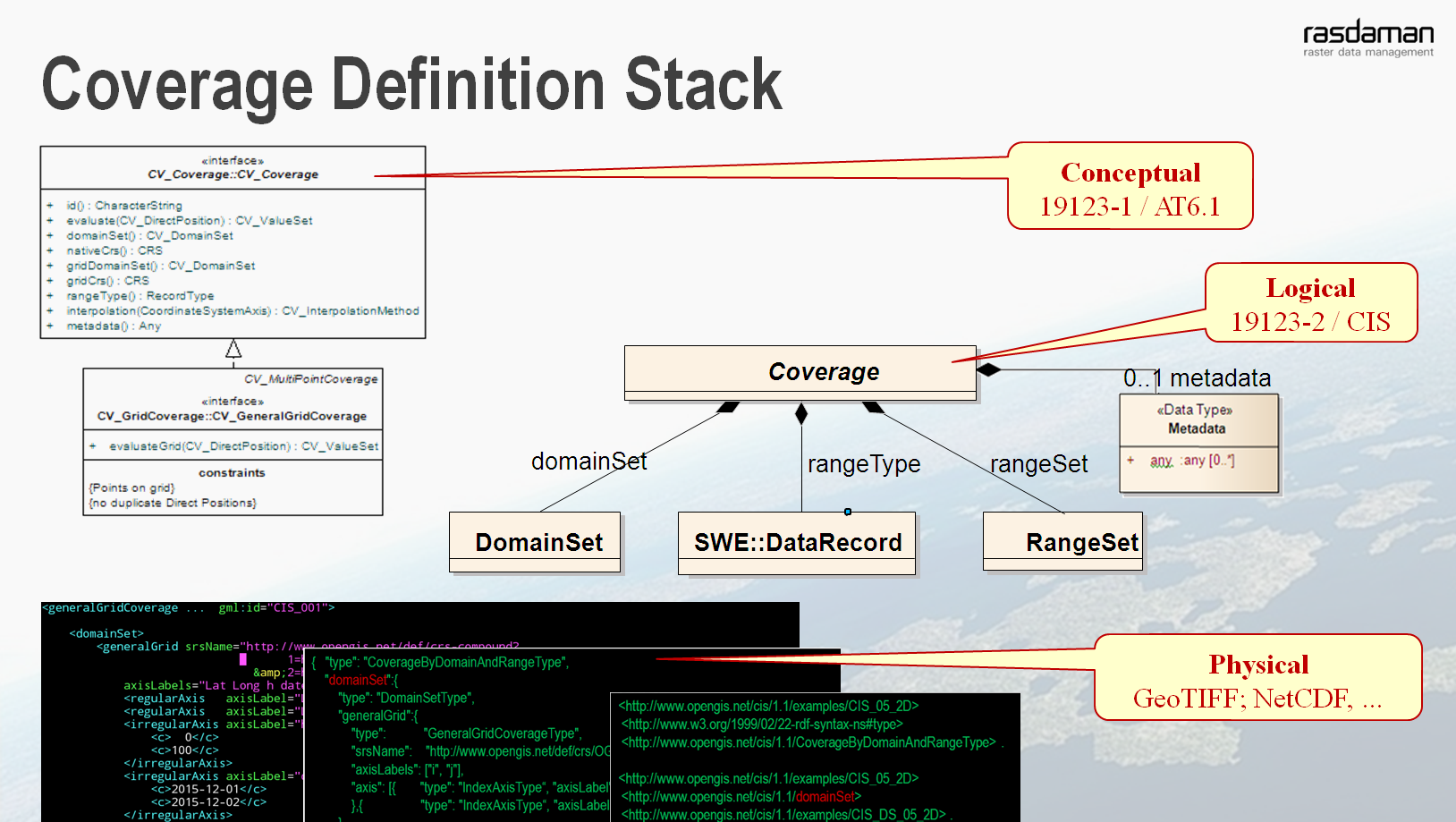
Notes:
- In the past, the distinction between these levels has not been made sufficiently clear in the standards. Often concepts were directly expressed in GML (more recently, in JSON) rather than separating them cleanly. In recent years, more attention has been paid at least in the WCS suite so the more recent standards split into separate documents (ex: ISO 19123-1 and 19123-2) or at least have separate conformance classes (ex: WCS service functionality vs request/response encoding). This trend, and also modularization, was pioneered by CIS/WCS.
- ISO 19123-1 and 19123-2 together replace ISO 19123:2005 which is phased out by ISO since 2023.
ISO
OGC and ISO TC211 WG6 Geo Imagery mutually adopt their geo standards so that these remain in sync. Below the components are listed with their normative references, including both OGC and ISO standards.
- ISO 19123-1:2023 - Coverage Fundamentals
- ISO 19123-2:2026 - Coverage Implementation Schema with XML schema and JSON schema, both with a large set of examples.
- ISO 19123-3:2023 - Coverage Processing Fundamentals
OGC
All coverage-related adopted standards - in particular: the CIS and WCS suites - can be found on the OGC WCS page, except for the WCPS language definition which is maintained separately for historical reasons. Further relevant are the official OGC WCS schema location and ISO EA UML model.
Abstract Coverage Model (conceptual level)
- Abstract coverage model:
- Topic 6.1 - Schema for coverage geometry and functions - Part 1: Fundamentals = ISO 19123-1
- Topic 6.3 - Schema for coverage geometry and functions - Part 1: Processing Fundamentals = ISO 19123-3 (note: there is no 6.2, numbering has been chosen in sync with ISO 19123 numbering)
Concrete Coverage Model (logical level)
- Data Model
- Coverage Implementation Schema (CIS) 1.2 -- under adoption from ISO 19123-2:2026; CIS 1.2 is an integration of CIS 1.0, CIS 1.1, and the Referenceable Grid Extension, hence backwards compatible (also with WCS 2). A more modern JSON schema has been added. The specification comes with amples examples in XML and JSON.
- Coverage Implementation Schema (CIS) 1.1 document and schemas for XML, JSON, RDF and examples; key features (see rationales) -- CIS 1.1 introduces class GeneralGridCoverage which is simplified and more powerful than the legacy CIS 1.0 grid distinction of Rectified / Referenceable Grid. It is backwards compatible to CIS 1.0.
- Coverage Implementation Schema - ReferenceableGridCoverage Extension to CIS 1.0 -- specifies ReferenceableGridCoverage (superseded by CIS 1.1 GeneralGridCoverage).
- Coverage Implementation Schema (CIS) 1.0.1 document and schema, OGC 09-146r2
- Service / Processing Model
- Web Service API
- WCS Core 2.1.0 document and schema (no change/update in syntax nor functionality over WCS Core 2.0.1 - only needed formally to allow CIS 1.1 coverages)
- WCS Range Subsetting Extension 1.0.0
- WCS Scaling Extension 1.0.0
- WCS CRS Extension 1.0.0
- WCS Interpolation Extension 1.0.0
- WCS Processing Extension 2.0.0
- WCS Transaction Extension 1.0.0
- WCS Earth Observation Application Profile (EO-WCS) 1.1 (supersedes v1.0)
- WCS MetOcean Application Profile 1.0.0 with Part 0 - MetOcean Metadata and Part 1 - MetOcean GetCorridor Extension and Part 2 - MetOcean GetPolygon Extension
- Coverage & Datacube Analytics:
- Web Coverage Processing Service (WCPS) 1.1.0 - extends WCPS 1.0.0 with a coverage constructor an integrated data/metadata handling for the latest CIS model; also basis for ISO 19123-3
- Coverage data / metadata integration:
- Web Query Service (WQS) 1.0, (Best Practice) - also available in WCPS 1.1
Coverage Data and Request Encodings (physical level)
- Coverage Format Encodings:
- GML Application Schema - Coverages - GeoTIFF Coverage Encoding Profile 1.0
- GML Application Schema - Coverages - JPEG2000 Coverage Encoding Profile 1.0
- CF-netCDF 3.0 encoding using GML Coverage Application Schema 2.0
- GRIB2 Encoding Profile 1.0
- Coverage Service Protocol Bindings:
EU INSPIRE
INSPIRE is the legal framework for a common European SDI. For raster data (generally: datacubes, coverages), INSPIRE has adopted WCS as Download Service, based on OGC CIS, WCS-Core and (optionally) WCPS.
- INSPIRE Good Practice library, containing coverages
- Technical Guidance for the implementation of INSPIRE Download Services using Web Coverage Services (WCS)
- INSPIRE Good Practice on github
Discussion and Workshops:
- INSPIRE Community Forum: An effective good practice to boost interoperable provision of (raster) INSPIRE Coverage data and services (local copy)
- INSPIRE workshop: Power of WCS/WCPS, Helsinki 2019
- INSPIRE conference workshop: Practicing INSPIRE coverages, Amsterdam 2018
Papers:
- K. Schleidt, P. Baumann: Interconnecting Sensor Data and Datacubes. Proc. IEEE Geoscience and Remote Sensing Society (IGARSS), July 28 - August 2, 2019, Yokohama, Japan
- P. Baumann, J. Escriu: INSPIRE Coverages: An Analysis and Some Suggestions. Open Geospatial Data, Software andStandards, 4(1)2019
Non-Coverage Documents
- CRS Name Type Specification
- WPS Application Profile - Coverages 2.0.0, Discussion Paper
Coverage-Incompatible Specifications
- OAPI-Coverages: work in progress, copying WCS, but with some incompatible changes; also not completely comatible with CIS - see more details
- GeoDataCubes: an initial-stage, defines two incompatible processing mechanisms, openEO and OAPI-Processes; also incompatible to CIS and WCS
- WCS 1.x: this deprecated predecessor of WCS 2 had its own coverage model which is incompatible with CIS
History
19123. ISO 19123:2005, which was technically outdated and had some known errors, was replaced in 2023 by ISO with 19123-1 and 19123-2.
WCS. The current version of WCS is 2.1. Functionally, it is identical to its predecessor WCS 2.0.1, but it extends the coverage types serviceable with GeneralGridCoverage as per CIS 1.1. This new coverage type unifies and simplifies grid coverages, in particular incorporating RectifiedGridCoverage! and ReferenceableGridCoverage as per WCS 2.0.
WCS 1 is the outdated, deprecated version of WCS. It is not compatible with WCS 2, as indicated by the major version number change (cf. OGC versioning rules). WCS 1, a stepstone in the learning curve about coverages, suffered from some known issues, in particular: lack of interoperability. It had its own coverage model which has been abondoned in WCS 2 for the sake of aligning with GML encoding. WCS 2 has several significant advantages over WCS 1: it relies on the GML coverage model, leading to increased interoperability as well as harmonization across OGC standards; among the main features are:
- extends beyond pure raster grids to support all coverage types, e.g., curvilinear grids, irregular grids, point clouds, surface coverages; general meshes;
- crisp and modular, consisting of a small mandatory core and a structured universe of optional extensions;
- harmonized with OGC OWS-Common, GML, SWE, WMS, WCPS, and WPS
- has a clear, formally specified syntax (XML Schema) and semantics (Schematron) easing understanding and implementation;
- testable: for the first time, pixel contents is subject to conformance testing. In other words: conformance of coverage data and services can be tested down to single pixel level.